7 Best Binoculars for Whale Watching (October 2026)
The best binoculars for whale watching include the Nikon Monarch M5 8x42 for tracking from a moving boat, the Vortex Triumph HD 10x42 for shore-side value, and the Vortex Diamondback HD 10x50 for dim shore conditions.
On this page (6 sections)
- How we chose binoculars for whale watching
- Which binoculars fit different whale watching trips?
- Are 8x or 10x binoculars better from shore or boat?
- Do 10x50 binoculars help in low light?
- What should you check before taking binoculars on a whale watching trip?
- Which binoculars should you choose for whale watching?
The Nikon Monarch M5 8x42 is our top pick for whale watching, with an 8x view and 335 ft field of view that can help you follow a surfacing whale. Choose a 10x model for more reach from shore, or a 50 mm pair for dimmer conditions.
The best fit depends on where you'll watch. A boat trip favors a wide field of view, while a fixed shore viewpoint leaves more room for 10x magnification or a tripod.
For broader outdoor use, see our guide to 8x42 binoculars for birding and nature and 10x42 binoculars for everyday outdoor use. If a long walk separates you from the shore, our guide to lightweight binoculars for travel and long walks can help you balance carry weight with reach.
Our picks at a glance
-
1

-
2

-
3

How we chose binoculars for whale watching
The best binoculars for whale watching need to help you find and track a moving animal from shore or a boat. We compared magnification, field of view, objective lens size, weather protection and carry features for those situations.
We scored the Nikon Monarch M5 8x42 first because its broad field of view and 8x magnification suit tracking. The other picks follow in descending score order, with 10x and 50 mm options for shore viewing and dimmer conditions.
Our score weighs specs, features and buyer feedback against what you're shopping for. We checked the product specifications but did not test these binoculars in the field.
| Product | Best for | Magnification | Objective lenses | Field of view | Our score |
|---|---|---|---|---|---|
| Nikon Monarch M5 8x42 | tracking from a moving boat | 8x | 42 mm | 335 ft | 8.9 |
| Vortex Triumph HD 10x42 | shore-side value | 10x | 42 mm | 9.0 | |
| Vortex Diamondback HD 10x50 | dim shore conditions | 10x | 50 mm | 315 ft | 8.5 |
| Celestron TrailSeeker 10x42 | wide-view 10x scanning | 10x | 42 mm | 6.5° | 8.2 |
| Nikon PROSTAFF P7 10x42 | bright, detailed shore views | 10x | 42 mm | 367 ft | 8.1 |
| Celestron Outland X 10x50 | budget-minded low-light viewing | 10x | 50 mm | 289 ft | 7.7 |
| Bushnell Engage X 10x42 | weather-exposed day trips | 10x | 42 mm | 7.7 |
Which binoculars fit different whale watching trips?
The Nikon Monarch M5 8x42 is the top pick for a moving boat, while shore watchers may prefer the reach of a 10x model. Choose a 50 mm option when a larger objective lens is more useful than a lighter carry.
Nikon Monarch M5 8x42: Best for tracking from a moving boat
- 8x magnification
- 335 ft field of view
- ED glass
- Waterproof and fogproof
The 8x view and broad field of view make it easier to keep a moving whale in sight. Its nitrogen-filled, O-ring-sealed housing is waterproof and fogproof.
Pros
- Broad field of view
- ED glass minimizes color fringing
- Comfortable long eye relief
Cons
- Less magnification than the 10x picks
- No harness included
The Nikon Monarch M5 8x42 is a strong fit when you need to keep a whale in view as it surfaces, dives or changes direction. Its 335 ft field of view and 8x magnification provide a broad view for scanning and following movement.
ED glass minimizes chromatic aberration and color fringing, while dielectric high-reflective multilayer prism coatings enhance light transmission. The nitrogen-filled, O-ring-sealed housing is waterproof and fogproof.
It weighs 1.4 lb and has 19.5 mm eye relief. It comes with a case, caps and neck strap.
Choose it for boat trips or general wildlife viewing where tracking matters more than extra magnification. For scanning from a fixed shore point, a 10x pair may bring distant activity closer.
Vortex Triumph HD 10x42: Best for shore-side value
- 10x magnification
- Fully multi-coated lenses
- Waterproof and fogproof
- GlassPak harness included
The 10x view gives distant shore watchers more magnification, while the included harness helps keep the binoculars close at hand. It is tripod adaptable for steadier extended viewing.
Pros
- Included GlassPak harness
- Tripod adaptable
- Waterproof, fogproof and shockproof
Cons
- Narrower view than the 8x42 pick
- 10x magnification can be harder to hold steady
The Vortex Triumph HD 10x42 suits shore watching when the whale is far offshore and you want more magnification. Its included adjustable GlassPak harness keeps it accessible between viewing points.
The fully multi-coated lenses support light transmission, while the HD optical system is designed to cut chromatic aberration. Nitrogen purging makes the binocular waterproof and fogproof, and rubber armor adds grip and impact protection.
It is tripod adaptable, which suits long scans from a fixed overlook. A tripod can also help steady the view.
Choose it for shore-based viewing and included carry gear. The Monarch M5's 8x magnification may suit a moving boat better.
Vortex Diamondback HD 10x50: Best for dim shore conditions
- 10x magnification
- 50 mm objective lenses
- Argon purged
- GlassPak harness included
The 50 mm objectives are a practical fit for watching in dimmer conditions from a stable shore spot. The included GlassPak harness supports carrying between viewing points.
Pros
- Larger objectives than the 42 mm picks
- Argon purged with O-ring seals
- Tripod adaptable
Cons
- Heavier than the 42 mm picks
- 10x view needs steadier hands
The Vortex Diamondback HD 10x50 suits shore watching when light is fading and you can keep the binoculars steady. Its 50 mm objective lenses are larger than the 42 mm lenses on most picks here.
Fully multi-coated lenses and dielectric coating are designed to support light transmission and color accuracy. Argon purging and O-ring seals provide water and fogproof performance, and the included GlassPak harness helps carry it between spots.
It weighs 1.9 lb. It is tripod adaptable, which can help at a fixed overlook.
Choose it for dim shore conditions and longer stationary scans. The Monarch M5 8x42 may be easier to point and follow from a moving boat.
Celestron TrailSeeker 10x42: Best for wide-view 10x scanning

- 10x magnification
- 6.5° field of view
- Waterproof magnesium alloy frame
- Harness strap included
This 10x42 combines higher magnification with a 6.5° field of view for scanning open water. The magnesium alloy frame is lightweight and waterproof.
Pros
- Wide 6.5° field of view
- Waterproof frame
- Harness strap included
Cons
- 15 mm eye relief
- Less objective diameter than the 50 mm choices
The Celestron TrailSeeker 10x42 combines 10x magnification with a stated 6.5° field of view for scanning open water. Its waterproof magnesium alloy frame is lightweight, and it includes a harness strap.
Phase and dielectric coatings on its BaK-4 prisms support light transmission, contrast and resolution. Twist-up eyecups with multiple stops allow you to position them with or without glasses.
It weighs 1.4 lb and has 15 mm of eye relief. If you wear glasses, check whether that eye relief gives you a full view.
Choose it for 10x reach with a wide stated field of view. The 8x Monarch M5 may be easier to use on a moving boat.
Nikon PROSTAFF P7 10x42: Best for bright, detailed shore views
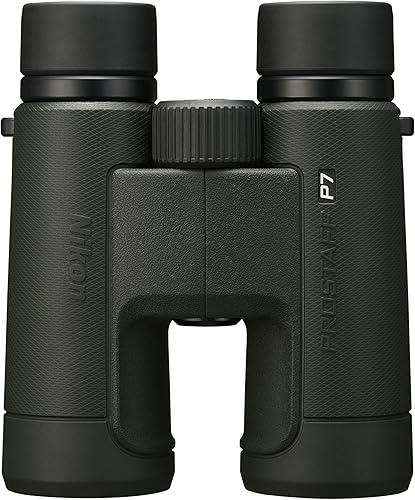
- 10x magnification
- 367 ft field of view
- Waterproof and fogproof
- Oil- and water-repellent lens coating
Its stated 367 ft field of view is broad for a 10x model, which helps when scanning a whale's path. The oil- and water-repellent lens coating can make it easier to wipe away moisture.
Pros
- Broad field of view for 10x
- Locking diopter ring
- Waterproof and fogproof
Cons
- No harness included
- 10x magnification calls for a steady hold
The Nikon PROSTAFF P7 10x42 pairs 10x magnification with a stated 367 ft field of view, making it an option for scanning a broad stretch of water from shore. Its locking diopter ring helps keep your focus setting in place once adjusted.
The waterproof, fogproof body has rubber armor and a fiberglass-reinforced polycarbonate frame. Oil- and water-repellent lens coatings can make it easier to wipe away spray or fingerprints.
It weighs 1.3 lb and has 15.7 mm eye relief. It includes a neck strap and case.
Choose it for shore use when you want a 10x42 with a broad stated field. The Triumph HD includes a harness if you want one in the box.
Celestron Outland X 10x50: Best for budget-minded low-light viewing

- 10x magnification
- 50 mm objective lenses
- Waterproof and nitrogen purged
- Tripod adaptable
The 50 mm objectives suit buyers who prioritize a larger lens for lower light, and tripod adaptability supports steadier views from shore. Its 289 ft field of view is narrower than several alternatives here.
Pros
- 50 mm objectives
- Waterproof and nitrogen purged
- Tripod adaptable
Cons
- Narrowest stated field of view in this group
- No harness included
The Celestron Outland X 10x50 suits shore viewing when larger objectives matter more than a broad field of view. Its 50 mm lenses and multi-coated optics are designed for bright, detailed views, and BaK-4 prisms support contrast and resolution.
It is waterproof and nitrogen purged, with a rubber-armored polycarbonate housing. It is tripod adaptable, but the adapter is not included.
Its stated field of view is 289 ft, the narrowest among the picks with a measurement in feet. A narrower view can make it harder to find a whale that surfaces briefly.
Choose it for a stationary shore spot and larger objectives. The Monarch M5 or TrailSeeker may suit scanning and tracking.
Bushnell Engage X 10x42: Best for weather-exposed day trips

- 10x magnification
- IPX7 waterproof
- EXO Barrier lens coating
- 620 g
The IPX7 waterproof rating and EXO Barrier coating suit a day near spray, dust or damp air. Its 620 g weight is a specific carry figure for comparing with your other gear.
Pros
- IPX7 waterproof rating
- EXO Barrier repels water, oil, fog, dust and debris
- 18 mm eye relief
Cons
- No field of view in feet provided
- No harness included
The Bushnell Engage X 10x42 suits a whale watching day when damp conditions and lens cleanup are concerns. Its IPX7 waterproof rating and EXO Barrier lens coating are designed for water, oil, fog, dust and debris.
Fully multi-coated optics support brightness and clarity, while twist-up eyecups are intended for viewing with or without glasses. It weighs 620 g.
Its field of view is given as 6.5°, which is not directly comparable to models listed in feet. It includes a neck strap and case and is tripod compatible.
Choose it for weather-exposed day trips where lens protection is a priority. For tracking from a moving boat, the Monarch M5 has a field of view stated in feet.
Are 8x or 10x binoculars better from shore or boat?
An 8x binocular can be easier to aim on a moving boat, while 10x magnification can help from shore. Boat movement adds shake, so a wide field of view and a steady grip matter when tracking a whale.
From shore, you can brace your arms or use a tripod adaptable model. That makes 10x42 or 10x50 binoculars more practical for distant whales.
The field of view guide explains how the view affects scanning and tracking. If you are comparing lens sizes, our 10x42 vs 10x50 binoculars guide covers the balance between size and light gathering.
Do 10x50 binoculars help in low light?
A 10x50 binocular may suit dimmer shore viewing because it has larger objective lenses than a 10x42 model. The extra size and weight can make it harder to carry and hold steady, particularly on a boat.
The Diamondback HD 10x50 weighs 1.9 lb and includes a harness. The Outland X 10x50 weighs 0.76 kg and can be tripod mounted.
If you want a lighter pair for a long approach to a viewpoint, see our guide to compact binoculars for cruises and day trips. Compact models trade lens size for easier packing, so check the magnification and field of view before choosing one for distant whales.
What should you check before taking binoculars on a whale watching trip?
Check whether the binoculars are waterproof or fogproof, how they carry, and whether you can focus them comfortably while holding a railing or standing on uneven ground. A neck strap or harness helps keep them close when you are not looking through them.
Use the lens caps when the binoculars are not in use, and clean the lenses with a lens cloth. Avoid wiping them with clothing or a rough towel, which can leave grit on the glass.
For a shore outing, tripod adaptability can help during long scans from a fixed position. Before the trip, adjust the binoculars to your eyes with our guide on how to adjust binoculars.
Which binoculars should you choose for whale watching?
Choose the Nikon Monarch M5 8x42 for boat trips and tracking, the Vortex Triumph HD 10x42 for shore viewing with an included harness, or the Vortex Diamondback HD 10x50 for dimmer shore conditions. Your viewing location and ability to hold a steady view should guide your choice.
For wider outdoor use beyond whale watching, compare our best binoculars for the money and browse the birding and travel binocular guide.
Our top 3 picks at a glance
-
1
-
2
-
3
Frequently asked questions
Are 8x or 10x binoculars better for whale watching?
An 8x binocular is often easier for following a whale because it gives a wider view and is less affected by hand movement. A 10x model brings a more distant whale closer, which can help from shore, but it takes a steadier hold.
For a boat trip, consider the boat's movement as well as the distance to the water.
Are 10x50 binoculars good for whale watching?
They can suit shore watching in dimmer light because 50 mm objective lenses are larger than 42 mm lenses. The tradeoff is a larger, heavier binocular to carry and hold steady.
A tripod adaptable model can help for long viewing from a fixed spot.
What matters most in binoculars for whale watching?
A useful field of view helps you find a whale and follow it as it surfaces or moves. Magnification, lens size, weather protection and how steadily you can hold the binoculars also matter.
Pick a combination that fits where you'll watch, rather than choosing the highest magnification alone.
Can I use binoculars on a whale watching boat?
Yes, but boat movement can make a high-magnification view harder to keep steady. An 8x pair with a broad field of view is a sensible starting point for tracking from a moving deck.
Keep the binoculars secured when not in use, and follow the crew's safety directions.


