8x42 vs 10x50 Binoculars: Which Should You Buy? (November 2026)
Choose 8x42 binoculars for steady, wide views and all-day carrying, and choose 10x50 for more reach and brighter low-light performance. For most birders and hikers, the 8x42 is the easier binocular to live with.
On this page (9 sections)
- 8x42 vs 10x50 binoculars at a glance
- Which size gives you a steadier view?
- How much does field of view matter?
- Which is brighter at dusk and dawn?
- How do the optics and coatings compare?
- How much weight will you carry?
- How does eye relief treat glasses wearers?
- Who should buy which?
- The verdict on 8x42 vs 10x50 binoculars
Choose 8x42 binoculars for steady, wide views and all-day carrying, and choose 10x50 for more reach and brighter low-light performance. In the 8x42 vs 10x50 binoculars comparison, most birders and hikers end up happier with the smaller size.
The numbers look close on paper: 8x against 10x, a 42mm lens against a 50mm lens. What separates them in the field is how steady you can hold the view, how wide it is and how much weight hangs from your neck.
Both sizes work for birding, hunting and general outdoor use. The right pick depends on your light conditions, your patience with hand shake and how long you carry the binocular.

8x42 vs 10x50 binoculars at a glance
The 8x42 wins on field of view, weight and steady holding; the 10x50 wins on reach and twilight brightness. Pick the trade-off that matches your days outside.
The table below puts the four models in this comparison side by side. The 8x42s both show 388 to 390 feet at 1,000 yards, while the 10x50s show 289 to 315 feet.
That difference is easy to feel when you swing onto a moving bird.
| Model | Magnification | Objective | Field of view | Exit pupil | Eye relief | Weight |
|---|---|---|---|---|---|---|
| Vortex Crossfire HD 8x42 | 8x | 42mm | 390 ft | 3.8mm | 14mm | 1.5 lb |
| Celestron Nature DX 8x42 | 8x | 42mm | 388 ft | 5.25mm | 17.5mm | 1.8 lb |
| Vortex Diamondback HD 10x50 | 10x | 50mm | 315 ft | 5mm | 17mm | 1.9 lb |
| Celestron Outland X 10x50 | 10x | 50mm | 289 ft | 4.8mm | 17.4mm | Not given |
| Product | Best for | Magnification | Objective lens | Field of view | Our score |
|---|---|---|---|---|---|
| Vortex Crossfire HD 8x42 | all-day birding | 8x | 42mm | 390 ft | 8.6 |
| Vortex Diamondback HD 10x50 | low-light viewing | 10x | 50mm | 315 ft | 8.5 |
| Celestron Nature DX 8x42 | budget birding pick | 8x | 42mm | 388 ft | 8.4 |
| Celestron Outland X 10x50 | budget 10x50 | 10x | 50mm | 289 ft | 7.7 |
Which size gives you a steadier view?
The 8x42 is steadier in the hand, and that matters more than the extra magnification for most people. Every step up in power magnifies your own hand shake along with the subject.
At 10x, small movements in your arms become large swings in the image. That is why many birders settle on 8x for long sessions where the binocular stays up at their eyes.
The 8x42 also brings a wider view, so you find a bird faster and keep it in frame as it moves. A 390-foot field beats a 315-foot one when a warbler flits through branches.
Hand shake isn't a reason to avoid 10x50 forever. Bracing against a tree, sitting down or using a tripod adapter all steady the view.
Both Vortex models and both Celestron models are tripod adaptable.
If your hands tire easily or you glass for an hour without a rest, the 8x42 is the kinder choice. If you can brace or mount the binocular, the 10x50's reach becomes usable.
Does magnification matter more than lens size?
No. Lens size controls light gathering and exit pupil, while magnification controls reach and how much you see at once.
The two work together, so compare them as a pair.
A 10x50 puts more detail on a distant animal. An 8x42 puts more of the landscape in view and is easier to keep still.
Neither advantage cancels the other.
How does 10x behave when you pan across open country?
At 10x the image sweeps past faster, so a slow, smooth pan matters. Hunters who glass a hillside in long, steady passes get the most from the magnification.
Birders who snap onto a flitting subject often find the 8x's slower apparent movement easier to follow.
The narrower view also means more time finding the subject before you can study it. That is the hidden cost of the extra reach, and it is why the steadier 8x wins for many people who glass on foot.
How much does field of view matter?
A wide field of view matters a lot for birds in flight and moving game; a narrow one is fine when your subjects sit still. The 8x42 models here show 388 to 390 feet, while the 10x50s show 289 to 315 feet.
Field of view tells you how much ground you see at 1,000 yards. Our explainer on binoculars field of view covers how to read the figure and why the apparent angle matters too.
For birding, a wider view helps you acquire a bird and follow it without dropping out of frame. For scanning a hillside for a deer that isn't moving, a narrower view costs you little.
Hunters who glass open country often accept the narrower 10x50 view because the magnification lets them judge antlers and count points. Birders in dense cover usually want the opposite trade.
The Celestron Outland X 10x50 has the narrowest view here at 289 feet. Its 5.6-degree angular figure is workable for scanning, but it takes more care to find a small, fast subject.
Which is brighter at dusk and dawn?
The 10x50 is brighter in low light because its larger lenses give a bigger exit pupil. Exit pupil is the light beam that reaches your eye, and bigger is brighter until your own pupil is the limit.
The Vortex Diamondback HD 10x50 delivers a 5mm exit pupil. The Vortex Crossfire HD 8x42 gives 3.8mm.
The Celestron Nature DX 8x42 manages 5.25mm despite its smaller lenses, while the Outland X 10x50 sits at 4.8mm.
That last pair shows why lens size alone doesn't decide brightness. Our guide to what is exit pupil in binoculars explains how magnification and objective size combine.
If you watch wildlife at dawn, sit in a blind until last light or hunt in deep timber, the 10x50's light gathering earns its place. If your sessions end before sunset, the 8x42's smaller pupil costs you little.
Coatings matter too. All four models use coated lenses, and the Vortex Diamondback HD adds a dielectric coating for brighter, color-accurate images.
The Nature DX uses phase-coated BaK-4 prisms for contrast.
Is a 10x50 always brighter than an 8x42?
No. The Celestron Nature DX 8x42 has a 5.25mm exit pupil, which beats the 4.8mm of the Outland X 10x50.
Compare exit pupil figures directly rather than assuming the bigger lens wins.
The math is simple: exit pupil equals the objective lens divided by the magnification. That is why a 42mm lens at 8x gives 5.25mm while a 50mm lens at 10x gives 5mm.
A 10x50 does not automatically beat every 8x42, and a well-made 8x42 can hold its own in fading light.
How do the optics and coatings compare?
All four binoculars are fully or multi-coated, and the Vortex pair and the Nature DX add extra coating steps for sharper, truer color. Coatings matter as much as the magnification number.
The Vortex Crossfire HD and Diamondback HD both use fully multi-coated lenses with anti-reflective coatings on all air-to-glass surfaces. The Diamondback HD adds a dielectric prism coating and Armortek protection on the exterior lenses.
The Celestron Nature DX 8x42 pairs fully multi-coated lenses with phase-coated BaK-4 prisms. That combination boosts contrast and resolution, which shows up on feather detail and shadowed subjects.
The Outland X 10x50 uses multi-coated lenses and BaK-4 prisms. It is a step below the fully multi-coated group, which is one reason its score sits lower.
Vortex calls the glass in both HD models "HD optics," selected elements that cut chromatic aberration. Our post on what is ED glass in binoculars explains how that glass type reduces color fringing at edges.
If crisp color and edge sharpness matter to you, the Vortex HD glass and the Nature DX's phase coating are the ones to weigh. For casual viewing in good light, the Outland X's coatings still deliver a usable image.
How much weight will you carry?
The 8x42 is lighter and easier on your neck over a long day. The Vortex Crossfire HD 8x42 weighs 1.5 pounds against 1.9 pounds for the Diamondback HD 10x50.
The 0.4-pound gap sounds small until hour five. Hanging from a neck strap, that extra weight pulls on your shoulders and makes the binocular swing as you walk.
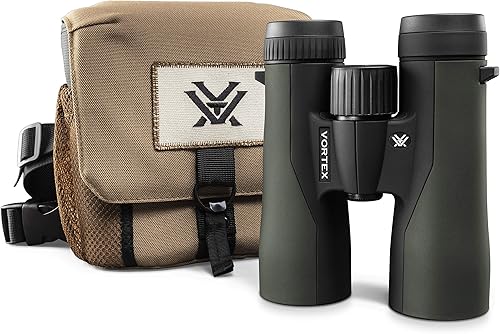
Both Vortex models ship with a GlassPak harness, which carries the load across your chest instead of your neck. That changes the weight question for both sizes.
The Celestron Nature DX 8x42 weighs 1.8 pounds, close to the Diamondback's 1.9. The 8x42 size doesn't guarantee a light body; check the figure for the exact model.
If you hike miles before you glass, the lighter 8x42 saves energy. If you ride to a stand or blind and sit for hours, the 10x50's extra weight matters less.
What comes in the box?
Both Vortex models include the GlassPak binocular case, the GlassPak harness, a comfort neck strap, tethered objective lens covers, a rainguard for the eyepiece and a lens cloth. The Celestron models ship with a carrying case, neck strap, objective lens caps, a rainguard and a lens cloth.
That matters for long carries. The harness in the Vortex box is the piece that makes either size easier to live with, and the Celestron pair leaves you to add one yourself.
The tethered objective covers on the Vortex also stay attached, so you are less likely to lose a lens cap in the field.
How does eye relief treat glasses wearers?
Longer eye relief is friendlier to glasses, and the 10x50s and the Nature DX lead here. The Vortex Crossfire HD 8x42 offers the shortest at 14mm.
The Diamondback HD 10x50 gives 17mm, the Outland X 10x50 gives 17.4mm and the Nature DX 8x42 gives 17.5mm. Anything around 15mm or more starts to work with thin frames.
The Crossfire HD's 14mm is tight for glasses. You can fold down or twist down the eyecups to gain room, but the view gets less comfortable.
If you wear glasses and want the wide 8x42 view, the Celestron Nature DX is the safer fit. If you don't wear glasses, the Crossfire HD's eye relief is a non-issue.
The Diamondback HD 10x50 and the Nature DX 8x42 also use twist-up eyecups, so you can set the eyecup position once and leave it. The Vortex pair and the Nature DX include a diopter adjustment for differences between your eyes, and the Outland X offers a plus or minus 3 diopter range.
Who should buy which?
Birders, hikers and glasses wearers should buy the 8x42; hunters and low-light watchers should buy the 10x50. Use your typical session to decide, not the spec sheet alone.
Pick the 8x42 if you fit one of these
- You birdwatch in cover and need to track fast, close subjects.
- You carry binoculars for hours and want the lightest option.
- You wear glasses and need at least 15mm of eye relief.
- You prefer a steady view without bracing or a tripod.
The Vortex Crossfire HD 8x42 is the top pick overall for most readers. Its wide view and light body make it the binocular you reach for without thinking.
If you wear glasses, the Celestron Nature DX 8x42 is the better 8x42 fit.
Pick the 10x50 if you fit one of these
- You glass open fields and need detail at long range.
- You watch at dawn or dusk and want the brightest image.
- You hunt from a stand or blind and don't hike far with the glass.
- You want a budget 10x50 and can accept a narrower view.
The Vortex Diamondback HD 10x50 is the strongest 10x50 here. The Celestron Outland X 10x50 is the budget route into the size, though its narrower field and smaller exit pupil trail the Diamondback.
How does 8x42 compare with other sizes?
The 8x42 sits in the middle of the common birding sizes. If you want to see how it lines up against a smaller objective, our post on 8x30 vs 8x42 binoculars covers the trade-offs in weight and light.
The verdict on 8x42 vs 10x50 binoculars
For most people, the 8x42 is the better buy: steadier, wider and lighter, with enough reach for birding and general wildlife. Pick the 10x50 only when long distance or low light is your main goal.
The 8x42 vs 10x50 binoculars decision comes down to your habits. If you walk, birdwatch in cover and want one binocular for everything, take the Vortex Crossfire HD 8x42 or the Celestron Nature DX 8x42.
If you sit still at dawn, hunt open country or simply want more magnification, the Vortex Diamondback HD 10x50 earns its extra weight. The Celestron Outland X 10x50 is the budget 10x50 when the Diamondback's price tier is too high.
Either way, a harness helps. Hanging 1.5 to 1.9 pounds from your neck all day is the fastest way to leave the binocular in the case.
Our guide to binoculars field of view is the next read if you want to judge wide versus narrow views before you buy.
Frequently asked questions
Are 10x50 binoculars better than 8x42?
Neither size is better in every case. 10x50 gives more magnification and a brighter low-light image, while 8x42 offers a wider view, less shake and less weight.
Pick by how you use them, not by the bigger numbers.
Are 10x50 binoculars too heavy to carry all day?
They are heavier than 8x42 models in the same line. The Vortex Diamondback HD 10x50 weighs 1.9 pounds against 1.5 pounds for the Crossfire HD 8x42.
A binocular harness spreads that weight across your chest and makes long days easier.
Is 8x enough magnification for birding?
Yes. 8x is the most common birding magnification because it holds steady in the hand and keeps a wide field of view for tracking birds in flight.
The Vortex Crossfire HD 8x42 shows 390 feet at 1,000 yards.
What does exit pupil have to do with low-light viewing?
Exit pupil is the width of the light beam leaving the eyepiece. A 10x50 gives a 5mm exit pupil and an 8x42 gives 3.8 to 5.25mm depending on the model, so larger objective lenses generally gather more light for dusk and dawn.
Do I need a harness for 10x50 binoculars?
A harness helps with either size. On heavier 10x50 models it takes the load off your neck and keeps the binocular steady against your chest.
On lighter 8x42 models it mainly keeps the glass from swinging while you walk.