8x30 vs 8x42 Binoculars: Which Size Fits You? (November 2026)
Pick 8x30 binoculars when you carry them all day and want a light, compact body. Pick 8x42 binoculars when you glass at dawn or dusk and want the brighter image from a larger lens.
On this page (10 sections)
- 8x30 vs 8x42: which format fits your day?
- Which one wins on light and exit pupil?
- Does an 8x30 field of view beat an 8x42?
- How much does the weight difference cost you?
- Which is easier to hold steady?
- Do you wear glasses, and does eye relief change the pick?
- Where does glass quality fit between the two?
- Which one suits hunting and which suits birding?
- Who should buy which?
- Which one should most people buy?
Pick 8x30 binoculars when you carry them all day and want a light, compact body. Pick 8x42 binoculars when you glass at dawn or dusk and want the brighter image from a larger lens.
The 8x30 vs 8x42 binoculars decision comes down to light and weight. Both magnify 8 times, so the image scale is the same.
The gap is the front lens: a 42mm lens gathers more light, a 30mm lens keeps the body smaller. Your habits decide which trade-off you want.

8x30 vs 8x42: which format fits your day?
Choose 8x30 for all-day carry and daylight viewing; choose 8x42 for dim light and long glassing sessions. Both describe an 8x magnification, and the second number is the diameter of the front lens in millimeters.
That lens sets brightness, weight and size.
A larger lens collects more light and adds bulk. The practical question is whether you notice the extra brightness more than the extra weight.
The split also shapes the body you hold. The Steiner 8x30 measures 6.7 by 2.2 inches and weighs 17.1 oz.
The Vortex 8x42 measures 6.3 by 5.2 inches and weighs 1.5 lb. The Celestron 8x42 is the heaviest at 1.8 lb.
Those inches and ounces decide whether the binocular lives in a jacket pocket or only in a pack.
| Feature | 8x30 | 8x42 |
|---|---|---|
| Magnification | 8x | 8x |
| Front lens | 30mm | 42mm |
| Exit pupil | 3.75mm | 5.25mm |
| Typical weight | about 1.1 to 1.2 lb | about 1.5 to 1.8 lb |
| Field of view | often wider | often narrower |
| Low-light use | limited | stronger |
What the size difference means in the field
The 8x30 format trades light for portability. A smaller tube means less glass to carry and less bulk against your chest.
On a long ridge walk that adds up by afternoon. The 8x42 spends that saved weight on a bigger front lens, and the reward is a brighter image when light is low.
Neither format is better in a vacuum. The choice depends on how many hours you carry the binocular and when you do most of your glassing.
Which one wins on light and exit pupil?
The 8x42 wins on light because its larger lens gives a bigger exit pupil. The exit pupil is the front lens size divided by the magnification.
An 8x30 gives 3.75mm and an 8x42 gives 5.25mm.
If you want the full math, this guide explains what the exit pupil is.
In bright daylight both look sharp. As the sun drops, the 8x42 keeps color and detail in the shadows while the 8x30 starts to dim.
That is why 8x42s are common among deer hunters and birders working in heavy cover. The last light of the day is often when animals move.
A word on low light and coatings
A bigger exit pupil only helps if the glass behind it is coated well. The Vortex 8x42 uses fully multi-coated lenses and HD glass elements.
The Celestron 8x42 goes further with phase-coated BaK-4 prisms, which lift contrast and resolution. A 42mm lens with weak coatings can look duller than a 30mm with good ones, so treat exit pupil as one input, not the whole answer.
Does an 8x30 field of view beat an 8x42?
Not always, but 8x30 models often show a wider view for the same magnification. A wide view helps you find a moving bird or an animal in the brush.
Field of view is the width of the scene you see at a set distance, usually measured in feet at 1,000 yards.
The Nikon PROSTAFF P3 8x30 offers 456 ft, the widest in this group. The Celestron 8x42 comes in at 388 ft and the Vortex 8x42 at 390 ft, close to the Steiner 8x30 at 362 ft.
So the format does not guarantee a narrow view. A smaller lens is easier to design with a wide angle, which is why compact 8x30s often lead a spec sheet.
For more on reading these numbers, see this guide to binoculars field of view.
A wide view matters most when you scan open country or follow birds in flight. A narrow field is fine when you pick a single subject and hold on it.
How much does the weight difference cost you?
An 8x42 weighs roughly half a pound more than an 8x30, and you feel that by mid-afternoon. The Steiner 8x30 at 17.1 oz and the Nikon 8x30 at 1.1 lb are easy to wear on a strap.
The Vortex 8x42 at 1.5 lb and the Celestron 8x42 at 1.8 lb ask more from your neck over a long day.
The fix is not to dismiss the 42mm. A chest harness takes the load off your neck and holds the binocular close, so it moves less when you raise it.
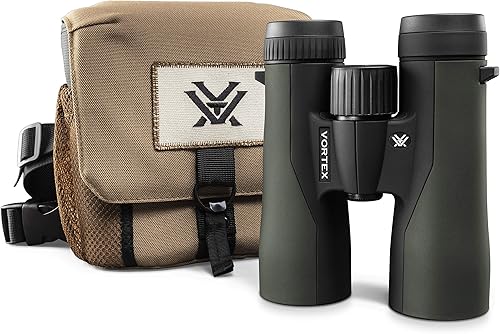
The Vortex 8x42 ships with a GlassPak harness in the box. Factor in a harness if you buy an 8x42 without one.
Compact bodies also fit smaller packs and glove boxes, so check the pocket or pouch you plan to use.
How the balance changes with carry style
The 8x30 shifts the center of gravity into your palms, so it hangs close and sits steady when you raise it. A heavier 8x42 can feel planted once you are set up, but it hangs lower and swings more when you walk.
A harness fixes most of that, but adds its own bulk. If you walk miles and glass on the move, the 8x30 body does more of the work.
If you settle in one spot and glass for hours, the extra weight of the 8x42 is easier to live with.
Which is easier to hold steady?
Both are easy to hold because 8x is a steady magnification, and the harness does the rest. At 8x, hand tremor barely shows in the image.
That is why birders and hunters pick 8x over 10x for long scanning sessions.
A chest harness helps because it supports the binocular against your body. For a close subject, the way you set the eyecups and diopter matters as much as the format, so follow these steps to adjust binoculars to your eyes.
A wider body like a 42mm gives your hands more to wrap around and can feel more planted. A compact 8x30 feels light and quick and rewards a light grip and a tucked-in stance.
Neither is harder to hold at 8x. Both formats also accept a tripod, so long sessions on one subject do not depend on arm strength.
The Vortex, the Celestron and the Nikon all have a tripod socket or mount.
Do you wear glasses, and does eye relief change the pick?
The 8x42 often wins for glasses wearers because larger eyepieces leave more eye relief. The Celestron 8x42 shows this best at 17.5mm.
Eye relief is the distance between the eyepiece and your eye where the full view appears.
Glasses add a gap, so you need more of it.
The Nikon 8x30 offers 15.4mm and the Vortex 8x42 offers 14mm, which is tight for thicker frames. The Celestron's 17.5mm sits in a comfortable range for most glasses.
Twist-up or turn-and-slide eyecups help too. The Celestron, the Vortex and the Nikon all have adjustable cups.
If you wear glasses and glass in low light, the Celestron 8x42 covers both needs. If you wear glasses and want a small body, the Nikon 8x30 is the better compact pick.
Setting the diopter on each format
Diopter adjustment lets each eyepiece match the difference between your two eyes. The Steiner lists a range of plus or minus 5 diopters.
The Vortex lists plus or minus 3 to 5 diopters. On the Steiner, the Sports-Auto-Focus system uses that one-time setting as its base.
You calibrate each eyepiece to your vision once, and the image stays sharp from 20 yards out. That makes the diopter setup more important than on a manual-focus binocular.
Where does glass quality fit between the two?
Glass quality can matter more than lens size, so do not judge a binocular by its front number alone. A well-coated 8x30 can beat a budget 8x42 in daylight.
Coatings and prism glass decide contrast and color.
The Celestron 8x42 uses phase-coated BaK-4 prisms, which help sharpness and contrast. The Vortex 8x42 uses fully multi-coated lenses and HD glass elements.
The Steiner 8x30 relies on its own high-contrast coatings and a floating prism mount that keeps the optics aligned after a drop. The Nikon 8x30 uses multilayer coatings and a silver-alloy prism coating.
None of these four carries ED glass, which cuts color fringing on bright edges. If that matters, read about what ED glass does in binoculars before you choose.
Between an 8x30 and an 8x42, spend on coatings before you spend on lens size. The other piece is build quality.
The Steiner's Makrolon housing and NBR rubber armoring are rated for 11 Gs of impact. The Nikon uses fiberglass-reinforced polycarbonate with rubber armor.
Both protect the glass, which is what keeps the image sharp over years of use.
Which one suits hunting and which suits birding?
Hunters who cover ground want the 8x30, and hunters who watch dim openings want the 8x42. Birders usually favor the 8x42 for close focus and eye relief.
For hunting, the Steiner 8x30 is the stand-out. Its Sports-Auto-Focus sets each eyepiece once, so everything from 20 yards to the horizon stays sharp without a focus wheel.
That suits scanning a hillside or tracking an animal on the move. The Vortex 8x42 suits the hunter who sits a stand or glasses at first and last light.
The 42mm lens gathers more light, and the GlassPak harness in the box spreads the weight across the chest.
For birding, the Celestron 8x42 brings a 6.5 ft close focus and long eye relief. That makes feeder birds and butterflies easy to see.
The Nikon 8x30 is a fine first pair for walks and travel, and its 456 ft field of view is the widest here for finding a bird in flight.
Quick match by activity
For open-country hunting on foot, choose the Steiner 8x30. For stand hunting at dawn and dusk, choose the Vortex 8x42.
For backyard and feeder birding with glasses, choose the Celestron 8x42. For travel and casual walks on a budget, choose the Nikon 8x30.
Who should buy which?
Buy the 8x30 if you walk far, glass in daylight and want the lightest body. The Steiner Military-Marine is the best 8x30 here for hard use, and the Nikon PROSTAFF P3 is the budget compact pick for casual trips.
Buy the 8x42 if you glass in low light, wear glasses or want one pair for everything. The Vortex Crossfire HD is the best low-light pick, and the Celestron Nature DX adds long eye relief and close focus for birding.
If you only own one pair and hunt both open country and deep timber, the 8x42 is the safer single choice. If you already own a 42mm and want a second, lighter pair, add an 8x30.
The two formats work as a pair: the 8x42 for the edges of the day and the 8x30 for the miles in between.
Which one should most people buy?
For most people the 8x42 is the better all-round buy, and the Vortex Crossfire HD is our pick from this group. It covers daylight and dusk, and the included harness handles the weight.
The Steiner Military-Marine 8x30 takes the top score here because its build and focus system suit the hunter who is always on the move.
Pick it if that describes you. Its 11 G impact rating, floating prism mount and transferable lifetime warranty make it the toughest 8x30 in this comparison.
If your glassing happens mostly in bright hours and you walk a lot, the 8x30 earns its place. If you want one pair for early starts, late sits and feeder watching, the 8x30 vs 8x42 binoculars question points to the 42mm.
Set either format up properly before you judge it. Dial in the eyecups and diopter, then compare them on the same subject at the same distance.
An 8x30 set up right can look brighter than an 8x42 set up wrong.
Frequently asked questions
Is 8x42 better than 8x30?
Not always. An 8x42 gathers more light because its 42mm lens is larger, so it wins at dawn and dusk.
An 8x30 is lighter and smaller, which wins when you carry it for hours.
What is the difference between 8x30 and 8x42 binoculars?
Both magnify 8 times. The number after the x is the front lens size in millimeters, so a 42mm lens collects more light than a 30mm lens.
That makes the 8x42 brighter but heavier.
Are 8x30 binoculars good for hunting?
Yes, if you cover ground on foot. The light body and wide view suit scanning hillsides through the day.
For the last 20 minutes of legal light or deep timber, a 42mm lens shows more detail.
Why does exit pupil matter in 8x30 vs 8x42 binoculars?
The exit pupil is the objective size divided by magnification. An 8x30 gives 3.75mm and an 8x42 gives 5.25mm, so the 8x42 passes more light to your eye in low light.
Can you hold 8x binoculars steady without a tripod?
Yes. An 8x is one of the steadiest magnifications for hand-held use.
A chest harness helps too, because it holds the binocular close to your body and reduces the shake when you bring it up.