Celestron vs Orion Binoculars: Which Brand Fits You? (November 2026)
Celestron is the safer pick for most people because its range covers birding, travel and astronomy at every budget. Orion suits stargazers who want dedicated astronomy binoculars from a telescope specialist.
On this page (8 sections)
Celestron is the safer pick for most people because its range covers birding, travel and astronomy at every budget. Orion suits stargazers who want dedicated astronomy binoculars from a telescope specialist.
This Celestron vs Orion binoculars comparison focuses on what each brand is actually built for, so you can match the name to your use.
The honest starting point is that these two brands do not compete on every shelf. Celestron sells a wide spread of roof- and Porro-prism pairs for day and night viewing.
Orion's binocular lineup sits mostly in the astronomy corner, which is where its telescope heritage shows.
 Best for deep-sky viewing
Celestron SkyMaster 15x70 Astronomy Binoculars
 Best for beginner stargazers
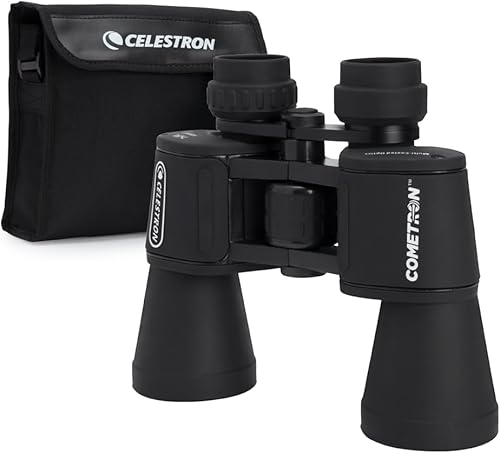
Celestron Cometron 7x50mm Astronomy Binoculars
Celestron vs Orion binoculars: the quick verdict
Choose Celestron for the widest choice across birding, travel and stargazing. Pick Orion when you want an astronomy-first brand and already know your night-sky targets.
Celestron's strength is breadth. You can move from an 8x42 waterproof birding pair to a 15x70 deep-sky binocular without leaving the brand, which keeps sizing and controls familiar.
That spread is why a first-time buyer usually lands on Celestron.
Orion's strength is focus. A telescope brand tends to build binoculars for stargazing first: larger objectives, Porro prisms and high magnification, with less attention to the compact daylight pairs birders carry.
If your main goal is the night sky, that specialization is a feature, not a flaw.
For most readers reading this on a phone in a store aisle, the practical answer is simple: buy Celestron unless you are shopping specifically for an astronomy binocular and Orion offers the exact magnification you want. Our Celestron brand rundown goes deeper on which Celestron lines suit birding.
The two brands side by side
Celestron covers more uses; Orion goes deeper on astronomy. This table sums up the brand-level differences that decide most purchases.
| Point | Celestron | Orion |
|---|---|---|
| Main reputation | Broad optics brand, telescopes and binoculars | Telescope specialist |
| Best-known binoculars | SkyMaster, Nature DX, Cometron | Astronomy Porro-prism pairs |
| Birding options | Strong, including waterproof 8x42 roof prisms | Limited |
| Astronomy options | Strong, from 7x50 to 25x70 | Strong and focused |
| Typical buyer | First-time buyer, all-rounder | Dedicated stargazer |
Celestron's SkyMaster line shows the astronomy side well. The 15x70 model pairs big 70mm lenses with BaK-4 prisms and includes a tripod adapter, so it is ready for long sessions without extra shopping.
Its 25x70 sibling pushes magnification higher for lunar and long-range detail.
The day side comes from pairs like the Nature DX 8x42. It is waterproof, nitrogen-purged and light at 1.8 pounds, with a wide 7.4° field for tracking birds in flight.
That range of roles is the core of the Celestron case.
Orion's case is simpler. If you want a brand that lives and breathes the night sky, its astronomy pairs are the point.
The trade-off is that a birder shopping Orion may find fewer waterproof roof-prism options for daylight walks.
What the specs say about each brand's philosophy
Celestron's specs split cleanly by use. The daylight pair, the Nature DX 8x42, runs a 42mm objective with an 8x magnification and a 5.25mm exit pupil.
That number tells you the image stays bright at dusk without the frame growing heavy. Its 7.4° angular field is the widest in the Celestron group here, and its 17.5mm eye relief works well for glasses wearers who fold down or twist up the eyecups.
The astronomy pairs swing the other way. The SkyMaster 15x70 runs a 59.9° apparent field with 18mm of eye relief, which keeps the view comfortable even though the true field narrows to 4.4°.
The 25x70 shows the trade-off most plainly: its 2.7° true field is less than a third of the Cometron's 6.6° angular view, so it is a pair for picking out a single target rather than sweeping the sky.
Read together, those numbers describe a brand that tunes each model to one job. Orion's smaller catalog means fewer such divisions to sort through, and a buyer who only wants an astronomy pair may find the choice quicker.
Which brand builds better daylight birding pairs?
Celestron wins this one for most birders because it sells purpose-built daylight pairs. Orion's range does not push as hard into compact, weather-sealed birding models.
Birding asks for specific things: moderate magnification that stays steady, a wide field for following movement, close focus for feeders, and weather sealing for wet mornings. An 8x42 roof prism hits all four, and Celestron's Nature DX 8x42 is a clear example.
It offers 8x magnification, a 7.4° field, close focus of 6.5 feet and a waterproof, nitrogen-purged body.
That combination matters more than brand loyalty. A birder who buys a 15x70 astronomy pair for a wetland walk gets a 3.3-pound frame that needs a tripod and a 4.4° field that is too narrow for tracking a warbler.
The specs fight the use.
Orion can still serve a birdwatcher who also stargazes and wants one pair to do both. In that case, a moderate 10x50 astronomy pair covers daylight viewing acceptably.
Just accept the extra weight and the narrower field compared with a dedicated 8x42.
The daytime details that tip the choice
Two spec lines matter most when you compare a birding pair against an astronomy pair. The first is close focus.
The Nature DX 8x42 reaches down to 6.5 feet, so a bird at a feeder or a butterfly on a flower fills the view. The Cometron 7x50, by contrast, has a close focus of 26.2 feet.
That is fine for the night sky and distant scenery, but it leaves near subjects soft.
The second is field of view. A wider true field lets you find a moving bird before it leaves the frame.
The Nature DX lists a 7.4° angular field, and the Cometron's 6.6° is close enough for open-sky scanning. The SkyMaster 15x70 drops to 4.4° and the 25x70 to 2.7°, so both are poor tools for following fast movement.
The third is the body. The Nature DX is waterproof and nitrogen-purged, which matters when rain or humidity fogs the inside of the lenses.
Celestron calls its SkyMaster pairs water-resistant rather than waterproof, so a wet morning favors the daylight model. That is the practical reason the birding answer lands on Celestron.
For a fuller look at daylight options, our Bushnell brand check covers another mainstream name and how its birding pairs stack up. A reader weighing three brands at once gets a better sense of the middle ground.
Which brand is better for stargazing?
Orion is the more focused astronomy brand, but Celestron's SkyMaster and Cometron pairs compete hard on specs. The gap is smaller than the reputations suggest.
Stargazing binoculars need light gathering and stability. Objective size drives the first; magnification and weight drive the second.
Celestron's astronomy range covers both ends of that scale. The Cometron 7x50 gathers light through 50mm lenses and stays light at 774 g with a wide 6.6° field.
The SkyMaster 15x70 steps up to 70mm lenses and BaK-4 prisms for faint objects, with a tripod adapter in the box.
Orion's astronomy pairs follow similar logic, with Porro prisms and large objectives. The difference is mostly in the catalog, not the physics.
A 70mm binocular gathers light the same way whichever name is on the barrel.
Where brand does matter is support and continuity. Celestron backs its binoculars with a limited lifetime US warranty and US-based tech support, which helps if a prism or eyecup needs attention years down the line.
For a first astronomy purchase, that kind of after-sales certainty counts.
The deciding question is magnification. If you want a wide sweep of the Milky Way, a 7x50 or 10x50 pair from either brand works.
If you want to pull detail out of the Orion Nebula or the lunar surface, go to a tripod-mounted 15x70 and compare the two brands on price and included accessories.
Prism glass and coatings, explained in plain terms
The two Celestron astronomy pairs differ in ways worth knowing before you pick a brand. The 15x70 and 25x70 both use BaK-4 prisms, which maximize light throughput and keep the view bright in dim conditions.
The Cometron 7x50 uses BK7 prism glass, a step below BaK-4 in light transmission. It compensates with a big 7.1mm exit pupil and multi-coated optics, so the view is still bright, but the edge sharpness and contrast will not match the BaK-4 models.
Coatings follow the same pattern. Celestron labels the Cometron and both SkyMaster pairs as multi-coated, while the Nature DX 8x42 adds phase coating on its BaK-4 prisms for better contrast and color accuracy.
If you compare Orion astronomy pairs against these, check whether they name BaK-4 and multi-coating, because those two specs drive the brightness you actually see.
How do magnification and objective size decide the brand?
Your target decides the specs, and the specs decide the brand. Once you know the magnification and objective size you need, the brand question usually answers itself.
Magnification sets reach. A 7x pair shows a wide slice of sky and stays steady in the hand.
An 8x pair is the birding sweet spot. A 10x pair adds detail without demanding a tripod for short looks.
A 15x or 25x pair needs support and steady air.
Objective size sets brightness. A 50mm lens gathers plenty of light for dawn, dusk and the night sky.
A 70mm lens goes further into faint objects but adds weight and bulk. The exit pupil, which is objective size divided by magnification, tells you how bright the view is: a 7x50 gives 7.1mm, a 15x70 gives 4.7mm, and a 25x70 drops to 2.8mm.
That last figure explains why the highest power is not always the best astronomy pick. A 25x70 shows more detail in good conditions but a dimmer image, and it magnifies atmospheric shimmer along with the target.
A 15x70 is the more forgiving deep-sky choice.
If you are also considering Meade, our Celestron vs Meade comparison applies the same spec-first method to another astronomy-leaning brand. The logic carries over: match magnification and objective size to the job, then choose the name.
Who should buy Celestron?
Buy Celestron if you want one brand that covers day and night viewing. It is the better fit for birders, travelers and first-time buyers who value choice and after-sales support.
The Nature DX 8x42 is the pair for most daylight use. It is light, waterproof and quick to focus, with a wide field that helps you find birds before they move.
A traveler who packs one pair for a trip gets daylight performance and acceptable stargazing in the same body.
The SkyMaster 15x70 is the pair for deep-sky viewing. Big 70mm lenses and BaK-4 prisms bring out faint detail, and the included tripod adapter means you can mount it without hunting for extra parts.
It is heavy enough at 3.3 pounds that you should plan on a tripod.
The Cometron 7x50 suits a beginner who wants a light pair for constellations and comet hunting. The wide field and 774 g weight make it easy to hold, and it works by day as well.
Skip Celestron only if you have already decided on a specific astronomy magnification that another brand offers at a better fit. Brand breadth is Celestron's edge, and it matters less once your target is locked in.
Who should buy Orion?
Buy Orion if the night sky is your main interest and you want a telescope brand's take on astronomy binoculars. It suits stargazers who already know their targets and want dedicated large-objective pairs.
Orion's astronomy pairs tend to favor Porro prisms, large objectives and high magnification. That is the right tool for someone who observes from a fixed spot with a tripod and wants to study clusters, nebulae and the moon.
The fit is weaker for a reader who wants one pair for a birding trip and a little stargazing on the side. A dedicated astronomy binocular is heavier and narrower than a daylight pair, and that trade-off shows up on a long walk.
Consider Orion when you have a tripod already and a list of deep-sky objects you want to chase. In that case, its focus on astronomy means fewer compromises in the catalog you are shopping.
For a reader weighing premium options as well, our Leupold brand check looks at where a premium name fits and when it is worth the step up. It helps frame whether Orion's mid-range astronomy pairs are the right stopping point.
Which brand should you choose?
For most readers, choose Celestron. It covers birding, travel and astronomy without forcing you into a specialist catalog, and its models come with a limited lifetime US warranty.
The Celestron vs Orion binoculars decision comes down to your target. If you want one pair for walks, feeders, trips and the occasional night sky, buy Celestron and start with the Nature DX 8x42 or the Cometron 7x50.
If deep-sky viewing is the whole point and you already own a tripod, Orion's astronomy focus is a fair reason to go that way.
One practical step before you buy: decide your magnification first. An 8x pair suits daylight and steady hands.
A 10x50 pair is a balanced first astronomy choice. A 15x70 needs a tripod and rewards it.
Match that number to how you will actually use the binoculars, then pick the brand that sells it with the accessories and support you want.
If you are still torn after matching specs, buy the pair whose included accessories save you a second purchase. Celestron's SkyMaster models ship with a tripod adapter, a rainguard and a carrying case, which covers most of what a first astronomy session needs.
A daylight pair that already has caps, a case and a neck strap in the box leaves less to buy on top.
Frequently asked questions
Is Celestron or Orion better for birding?
Celestron is the easier choice for birding because it sells compact, waterproof roof-prism pairs built for daylight use. Orion's lineup leans toward astronomy, so a bird-first buyer will find more suitable Celestron models.
Does Orion make binoculars as well as telescopes?
Yes. Orion is best known as a telescope brand and also sells astronomy binoculars, often large Porro-prism models aimed at stargazing.
Its range is narrower than Celestron's, which spans birding, travel and astronomy.
Which brand should a beginner stargazer choose?
Either brand can start you off, but Celestron's Cometron 7x50 is a low-effort entry with a wide field and a light frame. Pick the pair whose magnification and weight match how often you plan to observe.
Are 10x50 binoculars a good first astronomy pair?
Yes. A 10x50 pair balances light gathering and steady hand-held viewing, which makes it a common first astronomy choice.
If you plan long sessions on faint objects, step up to a tripod-mounted 15x70 or similar.
Why do astronomy binoculars need a tripod?
High magnification magnifies hand shake too, so 15x and 25x pairs blur without support. A tripod keeps the image still and lets you study faint objects for longer.
Celestron includes an adapter with its SkyMaster models.