Bushnell vs Nikon Binoculars: Which Fits You? (November 2026)
Nikon is the better pick for most people who view in low light or wear glasses, while Bushnell is the better value for casual daylight viewing. In this Bushnell vs Nikon binoculars comparison, the Nikon Monarch M7 10x42 wins overall for its ED glass and 16.5 mm eye relief.
On this page (8 sections)
Nikon is the better pick for most people who view in low light or wear glasses, while Bushnell is the better value for casual daylight viewing. In this Bushnell vs Nikon binoculars comparison, the Nikon Monarch M7 10x42 wins overall for its ED glass, dielectric coatings and 16.5 mm eye relief.
Bushnell puts a wide, fast-focus view in your hands for a budget price tier. Nikon spends more on glass, coatings and weather sealing.
Which one fits you depends on when you view and what you carry.


Bushnell vs Nikon binoculars at a glance
The Nikon Monarch M7 10x42 is the best overall binocular here, and the Bushnell Falcon 10x50 is the best budget buy. The table below lines up the two brands through four models, so you can see where the money goes.
| Model | Magnification | Objective | Prism | Eye relief | Field of view | Weather rating |
|---|---|---|---|---|---|---|
| Bushnell Falcon 10x50 | 12x | 50 mm | Porro | 9 mm | 300 ft | All-weather grip, not rated waterproof |
| Bushnell PowerView 10x50 | 10x | 50 mm | Porro | 10 mm | 113.2 ft | Rubber armor, not rated waterproof |
| Nikon Monarch M7 10x42 | 10x | 42 mm | Roof | 16.5 mm | 357 ft | Waterproof and fogproof |
| Nikon PROSTAFF P3 8x42 | 8x | 42 mm | Roof | 20.2 mm | 377 ft | Waterproof and fogproof |
The pattern is clear. Bushnell gives you bigger front lenses and higher power at a lower price tier.
Nikon gives you longer eye relief, wider fields of view and sealed bodies.
The exit pupil column tells the rest of the story. The Falcon and PowerView both work out to a 5 mm exit pupil, while the Monarch M7 lands at 4.2 mm.
A 5 mm exit pupil is easier to look through in dim light and more forgiving if your eye is not perfectly centered. The Monarch's 4.2 mm is tighter, yet its better coatings and ED glass do more with the light that reaches the eye.
This is why exit pupil alone does not settle the comparison.
| Product | Best for | Magnification | Objective lens | Prism | Our score |
|---|---|---|---|---|---|
| Bushnell Falcon 10x50 | budget daylight viewing | 12x | 50 mm | Porro | 9.7 |
| Bushnell PowerView 10x50 | hunting in camo | 10x | 50 mm | Porro | 9.6 |
| Nikon Monarch M7 10x42 | low-light birding | 10x | 42 mm | Roof | 9.5 |
| Nikon PROSTAFF P3 8x42 | glasses and all-day carrying | 8x | 42 mm | Roof | 8.5 |
The glass and coatings decide the view
Nikon wins on glass and coatings, and that shows up most in dim light and against bright backgrounds. The Monarch M7 carries ED glass and multilayer lens and prism coatings, which Nikon says deliver vivid, lifelike colors and maximum resolution.
ED glass is extra-low dispersion glass. It reduces the color fringing you see as purple or green edges on a bird against a pale sky.
That matters for birders and wildlife watchers who spend hours at the eyepiece.
The Monarch's roof prisms also get a dielectric multilayer coating. That boosts reflectance across the visible spectrum so colors stay natural.
Nikon also fits aspherical eyepiece lenses for edge-to-edge sharpness and an oil- and water-repellent coating that keeps smudges from building up.
The Bushnell Falcon uses fully coated Porro prism optics with BK7 glass. Coatings on a fully coated binocular sit on some air-to-glass surfaces, not all.
The result is a bright, usable daylight image without the color control of ED glass.
The PowerView steps up to BK-7 prism multi-coated optics. It adds an anti-reflective coating for brighter, crisper viewing than the Falcon in the same light.
It's still not in the same class as Nikon's ED glass.
The PROSTAFF P3 uses multilayer-coated lenses and a silver-alloy prism coating. The silver alloy reflects more of the visible spectrum than a plain coating, so colors read lifelike without the Monarch's dielectric layer.
Nikon lists 28.1 relative brightness for the P3, which helps at first and last light.
If you view mostly in daylight, the gap is smaller than you'd expect. If you view at dawn, dusk or under a forest canopy, the Nikon glass earns its keep.
Eye relief and eyeglass comfort
Nikon wins for eyeglass wearers by a wide margin. The PROSTAFF P3 offers 20.2 mm of eye relief and the Monarch M7 offers 16.5 mm.
Both let you keep your glasses on and still see the full field.
Bushnell's numbers are tighter. The Falcon gives 9 mm and the PowerView gives 10 mm.
Fold-down eyecups help, but short eye relief with thick frames often means you lose part of the view or press close to the lens. A 5 mm exit pupil does not fix that, because the problem is distance from the eyepiece, not the size of the light column.
This is the single spec to check first if you wear glasses. Long eye relief also keeps the view comfortable for anyone who doesn't want to jam their eye against the eyepiece.
Both Nikon models use turn-and-slide rubber eyecups. They click into place so you can set them for glasses or bare eyes and leave them there.
The Bushnell models use fold-down eyecups, which are simpler but less adjustable.
Adjusting for your eyes after the binocular arrives
Every binocular here needs a little setup before it feels right. The Nikons use a center focus wheel plus a diopter adjustment, so each eye can be corrected on its own.
The Monarch M7 allows +/- 4 diopters and the PROSTAFF P3 a similar range.
Here is the routine. Set the diopter to zero, close your right eye and focus the center wheel with your left until the view is sharp.
Then open the right eye and turn the diopter ring until that side is sharp too. Leave the center wheel for distance changes from then on.
Bushnell's InstaFocus system works differently. It's a lever-style focus that moves fast, which is why it suits moving targets like a ballgame.
The tradeoff is that very fine focus at a fixed distance can feel touchy, so expect a little hunting for the sweet spot.
Our guide on whether Bushnell binoculars are good covers how the brand's coatings and builds compare across its range. If you want the full Nikon roof-prism picture, the PROSTAFF vs Monarch comparison walks through the next model up.
Field of view and magnification
Bushnell wins on raw power; Nikon wins on usable width. The Falcon gives you 12x magnification and a 300 ft field of view at 1,000 yds.
That reach suits stadium sports and wide landscapes.
The PowerView runs 10x with a narrower 113.2 ft field. That tight view makes it easier to miss a bird in flight while you find it in the eyepiece.
Its 6.5 degree apparent angle of view is wider on paper than the Falcon's 5.7 degrees, but the real field at 1,000 yds is what your eye actually sees, and that is where the Falcon stays broader.
Nikon's pair are wider still. The Monarch M7 10x42 gives 357 ft at 1,000 yds and the PROSTAFF P3 8x42 gives 377 ft.
A wider field helps you locate fast-moving subjects, which is why birders favor it. The P3's 53.4 degree apparent angle of view keeps that width feeling natural rather than tunnel-like.
Magnification cuts both ways. The Falcon's 12x shows more detail at distance, but it also magnifies hand shake.
Without a rest, 12x gets shaky faster than 8x or 10x. A simple rule helps: every step up in magnification needs a steadier hold or a support.
The PROSTAFF P3's 8x is the steadiest hand-held option here. The Monarch's 10x splits the difference between reach and stability.
If you plan to mount the binoculars, the PowerView is tripod-compatible. A steady mount turns extra magnification into usable detail.
A tripod also fixes the PowerView's narrow field problem, because you can pan slowly instead of sweeping the whole scene at once.
Build, weather sealing and carrying
Nikon wins on weather sealing; Bushnell wins on grip and price. Both Nikon models are waterproof and fogproof, with nitrogen purging and O-ring seals that keep moisture out through rain, snow and rapid temperature swings.
Nikon rates the PROSTAFF P3 waterproof down to 3.3 ft, with the note that it is not meant for underwater use.
The Monarch M7 adds oil- and water-repellent lens coatings. Smudges and fingerprints wipe away more easily, which helps on wet mornings.
The Bushnell Falcon and PowerView have rubberized armor and non-slip grip pads. That gives you a confident hold in wet weather without claiming a sealed body.
Treat them as fair-weather tools. A fogged or waterlogged binocular is a paperweight, so pack them away when the sky turns.
Weight matters if you carry binoculars for hours. The PROSTAFF P3 weighs 1.3 lb and the Monarch M7 1.5 lb.
The Falcon runs about 27 oz (830 g), which is heavier than both Nikons and sits around your neck longer. A wide neck strap helps on a long day, but the lighter Nikon bodies are easier on the shoulders from the start.
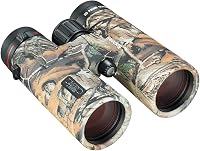
The PowerView's Realtree AP camo finish suits hunters who want the glass to blend into cover. Its compact Porro housing stores easily in a pack.
The P3's fiberglass-reinforced polycarbonate body and rubber armor give it drop protection without much weight.
Roof-prism Nikons are slimmer and easier to slip into a jacket pocket. Porro-prism Bushnells are wider and bulkier but often brighter for the money at large objective sizes.
Who should buy which brand?
Pick Nikon if you view in low light, wear glasses or get caught in weather. Pick Bushnell if you want a capable daylight binocular at a budget price tier.
Here's how the four models break down by buyer.
Buy the Bushnell Falcon 10x50 if...
You want a budget pair for stadium sports, concerts or sightseeing. Its 12x power reaches far and the InstaFocus system locks onto moving targets quickly.
The 300 ft field of view keeps the scene wide.
It's the best budget buy here. Skip it if you wear glasses or plan to view at dusk, because the 9 mm eye relief and BK7 glass hold you back.
Buy the Bushnell PowerView 10x50 if...
You hunt or hike and want camo plus a tripod mount. The Realtree AP finish blends into cover, and the tripod-compatible housing steadies long glassing sessions.
The 10x view is easier to hold than the Falcon's 12x.
Buy the Nikon Monarch M7 10x42 if...
You bird at dawn or dusk and want colors to stay true. ED glass and dielectric prism coatings give it the best optics here, and the waterproof, fogproof body handles rain.
The 16.5 mm eye relief works with glasses. The +/- 4 diopter range also lets most eyeglass wearers fine-tune each eye.
It's the best overall pick for most people who take binoculars seriously.
Buy the Nikon PROSTAFF P3 8x42 if...
You wear glasses and carry binoculars all day. The 20.2 mm eye relief is the longest in this comparison, the 8x view stays steady in the hand, and the 1.3 lb body is light.
The 377 ft field is the widest here. Its 20.2 mm eye relief even leaves room for thick frames.
If you're weighing Nikon's own models against each other, our Monarch M5 vs PROSTAFF P3 comparison is the natural next read.
Budget and what you actually get
Bushnell sells reach and light gathering for less; Nikon sells optical quality and sealed construction. Neither brand is "better" in a vacuum.
You pay for different things.
Bushnell's Falcon and PowerView both use 50 mm objective lenses. A larger objective gathers more light at the same magnification, which helps in dim conditions.
That's why a 10x50 Bushnell can feel brighter than a 10x42 Nikon in fading daylight.
But the Nikon's coatings and ED glass keep the image sharper and truer where it counts. At a 42 mm objective, the Monarch M7 still holds its own thanks to better light transmission.
The PROSTAFF P3 pairs its 42 mm lenses with Nikon's multilayer coatings and a silver-alloy prism, so it also punches above its exit pupil number.
Nikon's price tier is higher, and that money goes into glass, sealing and eyecups. Bushnell's lower price tier goes into magnification and a rubber grip.
That trade is worth knowing before you buy, because it decides which binocular you will actually enjoy using.
Our look at whether Leupold binoculars are good shows where a third brand sits on that same scale. If you're also comparing roof-prism rivals, the Athlon vs Vortex comparison covers two more names that compete on value and glass.
Which one should you buy?
The Nikon Monarch M7 10x42 is the best overall Bushnell vs Nikon binoculars pick for most readers, and the Bushnell Falcon 10x50 is the best budget buy. Pick the Monarch for low light, true colors and weather resistance.
Pick the Falcon for daylight sports and travel on a budget.
Here's the decision rule. If you wear glasses, the Nikon PROSTAFF P3's 20.2 mm eye relief makes it the easiest to use.
If you hunt and want camo with a tripod mount, the PowerView fits. If you want a first pair that handles a wide daylight scene, the Falcon delivers for less.
Nikon wins the head-to-head because its glass and sealing do more for the serious viewer. Bushnell wins when price and magnification are your top concerns.
Neither verdict should surprise anyone who has looked through both.
Either way, buy the model whose eye relief and field of view match how you actually view. A budget binocular you can hold steady beats a premium one you can't keep steady.
A pair that stays in its case helps no one.
If you want to keep comparing brands before you commit, our Athlon vs Vortex comparison covers two more value-focused names.
Frequently asked questions
Is Nikon better than Bushnell for birding?
Nikon is the stronger birding pick when light is dim or colors matter. The Monarch M7 uses ED glass and multilayer coatings that keep feathers and foliage true, while Bushnell models like the Falcon and PowerView rely on fully or multi-coated BK-7 optics built for daylight.
Are Bushnell binoculars good enough for a first pair?
Yes. A Bushnell Falcon or PowerView gives you a wide view and fast focus at a budget price tier, which suits casual sports, travel and backyard viewing.
Move up to Nikon when you start birding at dawn or want a view that stays sharp in low light.
What does eye relief mean for glasses wearers?
Eye relief is the distance from the eyepiece to your eye where the full view appears. The Nikon PROSTAFF P3 gives 20.2 mm and the Monarch M7 gives 16.5 mm, both comfortable with glasses; the Bushnell Falcon gives 9 mm and the PowerView 10 mm, which is tight for thick frames.
How much magnification do I need?
Pick 8x for steady hand-held viewing and a wide field, 10x for a balance of reach and steadiness, and 12x for distant detail when you can brace or mount the binoculars. The Falcon's 12x reaches farthest here but is the hardest to hold still.
Which brand is more waterproof?
Both Nikon models here are waterproof and fogproof with nitrogen purging and O-ring seals. The Bushnell Falcon and PowerView have rubberized, all-weather grips but do not carry the same waterproof and fogproof rating, so keep them out of heavy rain.