Vortex Diamondback HD 8x42 vs 10x42: Which Is Better? (November 2026)
Choose the Vortex Diamondback HD 8x42 for most people. Its wider field of view, larger exit pupil, longer eye relief and lighter design make it easier to carry and use, while the Vortex Crossfire HD 10x42 suits distant subjects and tripod-supported viewing.
On this page (11 sections)
- Vortex Diamondback HD 8x42 vs 10x42: quick verdict
- How do the two Vortex binoculars compare side by side?
- Why does 8x42 offer an easier handheld view?
- When is 10x magnification the better choice?
- Which model gives the more forgiving light view?
- How do the lens coatings and protection compare?
- Which binocular is easier to set up for glasses?
- Who should buy the Diamondback HD 8x42?
- Who should buy the Crossfire HD 10x42?
- How should you carry and care for either binocular?
- Which Vortex binocular should you choose?
Choose the Vortex Diamondback HD 8x42 for most people. In this vortex diamondback hd 8x42 vs 10x42 comparison, the 8x42 wins overall with a wider field of view, a larger exit pupil, longer eye relief and a much lighter listed weight.
The Vortex Crossfire HD 10x42 is the better pick when distant subjects deserve extra magnification. Its 10x power brings more reach, but the narrower view, smaller exit pupil and heavier 1.4-pound weight make it less forgiving for general use.
Both models pair 42mm objective lenses with HD optics, fully multi-coated lenses, center focus and adjustable eyecups. Both are tripod adaptable, water and fogproof, and protected by Vortex's unlimited, unconditional, transferable lifetime VIP Warranty under its stated terms.

Vortex Diamondback HD 8x42 vs 10x42: quick verdict
The Diamondback HD 8x42 is the better all-around binocular, while the Crossfire HD 10x42 is the better distance-first option. That difference comes from how magnification changes the view you see and how steady the binocular feels in your hands.
The 8x42 provides 8x magnification and a 393-foot field of view. That wider window makes it easier to locate a bird, follow movement through branches or scan a landscape without constantly repositioning the binoculars.
The Crossfire provides 10x magnification and a 325-foot field of view. The extra power helps distant subjects appear larger, but the narrower window demands more careful aiming when a bird moves or an animal enters from the side.
For handheld travel, birding and casual wildlife viewing, the Diamondback earns the higher 8.8 score. For distant wildlife watched from a stable position, the Crossfire's 8.7 score reflects a useful advantage in reach.
The choice is not about which number is always better. It is about whether you value a wider, easier view or more magnification on faraway subjects.
How do the two Vortex binoculars compare side by side?
The Diamondback HD 8x42 leads in field of view, exit pupil, eye relief and weight. The Crossfire HD 10x42 leads in magnification and includes a low-light capability description.
| Feature | Vortex Diamondback HD 8x42 | Vortex Crossfire HD 10x42 |
|---|---|---|
| Magnification | 8x | 10x |
| Objective lenses | 42mm | 42mm |
| Field of view | 393 ft | 325 ft |
| Apparent angle of view | 7.5 degrees | 6.2 degrees |
| Exit pupil | 5.25mm | 4.2mm |
| Eye relief | 17mm | 15mm |
| Focus | Manual, center focus | Manual, center focus |
| Weight | 8 ounces | 1.4 pounds |
| Lens coating | Fully multi-coated | Multiple anti-reflective coatings |
| Armor | Rubber | Rubber |
| Purging and seals | Argon, O-ring | Nitrogen, O-ring |
| Tripod use | Tripod and car window mount adaptable | Tripod adaptable |
The shared 42mm objective size means both gather light through lenses of the same diameter. The main optical difference comes from magnification, field of view and exit pupil rather than objective size.
Both use adjustable eyecups that twist up and down. Both have a center focus wheel and a right-eyepiece diopter for matching the focus to differences between your eyes.
Why does 8x42 offer an easier handheld view?
The Diamondback HD 8x42 is easier to aim and follow because its 393-foot field of view is wider. It also weighs 8 ounces, giving it a clear carrying advantage over the 1.4-pound Crossfire HD 10x42.
A wider field helps when your subject is moving. You can find a bird in a tree, follow an animal crossing open ground or scan a shoreline with less need to move the binoculars.
The 7.5-degree apparent angle of view also supports that open feel. The Crossfire's 6.2-degree apparent angle is narrower, which matches its more focused 10x view.
Weight matters during long walks and repeated glassing stops. An 8-ounce binocular is less demanding to carry than a 1.4-pound model, especially when you already have a harness, camera or other field gear.
The lighter Diamondback also suits shared use. A family member or occasional user can bring it to a trail, park or event without carrying as much weight.
If the subject is very far away, the Crossfire can still be the better optical choice. For regular handheld use, however, the Diamondback's wider view and lighter body are more useful advantages.
When is 10x magnification the better choice?
Choose the Crossfire HD 10x42 when distant subjects are the main reason you carry binoculars. Its 10x magnification gives more reach than the Diamondback's 8x power.
That extra magnification suits distant wildlife, far slopes and subjects viewed from an open position. It helps when you want more enlargement and can keep the binoculars steady while focusing.
The trade-off is a narrower 325-foot field of view. Finding a moving subject takes more care because less of the surrounding scene appears at once.
Ten-power binoculars also make hand movement more visible. A tripod or car window mount can turn the Crossfire into a steadier observation tool when you plan to stay in one place.
The Crossfire's center focus wheel adjusts both barrels together, while the right-eyepiece diopter handles differences between your eyes. Set those controls before a long viewing session so you are not repeatedly adjusting them in the field.
For a distant subject that stays still, 10x is the stronger fit. For a bird that suddenly flies across your view, 8x is usually easier to manage.
Which model gives the more forgiving light view?
The Diamondback HD 8x42 has the larger exit pupil at 5.25mm, compared with 4.2mm for the Crossfire HD 10x42. That larger exit pupil makes the Diamondback the more forgiving option as daylight becomes less intense.
Both binoculars use 42mm objective lenses, so their front lens diameter is the same. The different magnification levels change the exit pupil, which is the circle of light reaching your eye.
A larger exit pupil makes it easier to position your eyes behind the eyepieces and maintain a comfortable view. That matters when you are walking, wearing glasses or moving between bright and shaded areas.
The Diamondback also has 17mm of eye relief. The Crossfire has 15mm.
Longer eye relief gives eyeglass wearers more room to see the full image when the eyecups are adjusted down.
Neither model should be described as a night-vision binocular. Their practical difference is the more forgiving 8x42 optical setup versus the more magnified 10x42 setup.
If you often glass during early morning, late afternoon or under tree cover, choose the Diamondback. If you mainly observe in bright daytime and need reach, the Crossfire's smaller exit pupil is less important.
How do the lens coatings and protection compare?
Both models use optical coatings and protective exterior features for regular outdoor use. The Diamondback uses fully multi-coated lenses, dielectric coating and Armortek exterior lens protection.
The Diamondback's fully multi-coated lenses place anti-reflective coatings on all air-to-glass surfaces. Its dielectric coating supports bright, clear and color-accurate images, while Armortek protects exterior lenses from scratches, oil and dirt.
The Crossfire uses multiple anti-reflective coatings on all air-to-glass surfaces. Its HD optics are described with edge-to-edge sharpness, color fidelity and light transmission.
Both use rubber armor for a secure, non-slip grip and external protection. That shared grip matters when your hands are cold, the binoculars are damp or you are moving between viewing locations.
The Diamondback has argon purging and O-ring seals for water and fogproof performance. The Crossfire has nitrogen purging and O-ring seals for the same stated water and fogproof performance.
Vortex describes both as rugged and able to withstand recoil and impact. Those statements support outdoor and hunting use, but they do not remove the need to use lens covers, keep the optics clean and store the binoculars safely.
For a closer look at a different Vortex option, compare the Vortex Crossfire HD 12x50 when a larger objective and stronger magnification fit your viewing plans.
Which binocular is easier to set up for glasses?
The Diamondback HD 8x42 is the better glasses-friendly choice because it provides 17mm of eye relief, compared with 15mm for the Crossfire. Both models use twist-up and twist-down eyecups.
Start with the eyecups lowered if you wear glasses. This brings your eyes closer to the eyepieces and helps you use the available eye relief.
Set the center focus wheel while viewing a clear object. Then close or cover your right eye and focus the left barrel.
Open the right eye, close or cover the left eye and use the diopter on the right eyepiece to balance the image.
After that setup, use the center focus wheel for normal viewing. The diopter is for matching the binocular to your eyes, not for replacing the main focus adjustment each time you change distance.
The Diamondback's longer eye relief gives more room for glasses. The Crossfire still has adjustable eyecups and 15mm of eye relief, so it remains usable when adjusted correctly.
If several people share the binoculars, each user should reset the eyecups and focus. Marking a personal diopter position can make repeated setup faster without changing the optical controls for someone else.
Who should buy the Diamondback HD 8x42?
Buy the Vortex Diamondback HD 8x42 for birding, travel, hiking and general wildlife viewing. Its 393-foot field of view, 5.25mm exit pupil, 17mm eye relief and 8-ounce weight support the widest range of everyday use.
It suits birders who need to find small moving subjects quickly. The 8x view keeps more of the surrounding scene visible, so you can follow movement without losing the subject as easily.
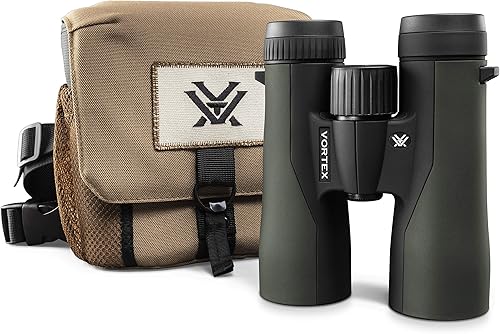
Travelers also benefit from its lighter weight. The included GlassPak harness gives you a carrying option when you want the binoculars ready without holding them in your hands.
The Diamondback works with standard tripods and car window mounts. That gives it flexibility for roadside viewing or longer observation sessions, even though its main advantage is handheld ease.
Its rubber armor, water and fogproof construction and rugged design fit changing outdoor conditions. The objective lens covers, rainguard eyepiece cover and lens cloth support routine field care.
For another 8x42 comparison point, read the Nikon Monarch M5 8x42 review. If your decision is between Nikon lines, the Nikon PROSTAFF vs Monarch comparison covers a different 8x42 choice.
Who should buy the Crossfire HD 10x42?
Buy the Vortex Crossfire HD 10x42 for distant wildlife, open landscapes and tripod-supported viewing. Its 10x magnification gives far subjects more enlargement than the Diamondback HD 8x42.
It makes sense when your usual observation point is stable and the subject is far away. A tripod can reduce the effect of hand movement and make the narrower 325-foot view easier to use.
The Crossfire also has HD optics with edge-to-edge sharpness and a low-light capability description. Its fully multi-coated lenses use multiple anti-reflective coatings on all air-to-glass surfaces.
The 1.4-pound weight is the main carrying trade-off. It is heavier than the Diamondback's 8 ounces, so it suits buyers who value reach more than a light load.
The Crossfire includes a GlassPak binocular harness, comfort neck strap, tethered objective lens cover, rainguard eyepiece cover and lens cloth. Its rubber armor, nitrogen purging and O-ring seals support outdoor handling.
Choose the Crossfire when you already know that 8x does not give enough reach. If you are unsure and expect mixed use, the Diamondback's wider view and lighter weight make it the safer overall choice.
How should you carry and care for either binocular?
Use the included carrying gear, keep the lenses covered when you are not viewing and clean the glass with a lens cloth. Both models are built for outdoor use, but simple care protects the optical surfaces and focus controls.
Carry the binoculars in the GlassPak option included with each model. A harness keeps the binoculars close to your body and ready for use, while the case helps protect them between viewing stops.
Use the tethered objective lens covers when the binoculars are hanging or stored. Keep the rainguard eyepiece cover in place when rain, dust or loose debris could reach the eyepieces.
Brush or blow loose grit away before wiping a lens. Use the lens cloth for light marks rather than rubbing dirt across the glass.
The Diamondback's Armortek coating protects its exterior lenses from scratches, oil and dirt. That coating still benefits from careful handling and clean storage.
Both models are water and fogproof through their purge and O-ring construction. Avoid treating that protection as permission for careless immersion or rough storage.
For longer viewing, attach the binoculars to a compatible tripod when a stable position helps. The Diamondback also works with car window mounts, while the Crossfire's listed compatibility is tripod use.
Which Vortex binocular should you choose?
Choose the Diamondback HD 8x42 for the best overall balance. It wins the vortex diamondback hd 8x42 vs 10x42 decision for most readers because the wider 393-foot view, larger 5.25mm exit pupil, longer 17mm eye relief and 8-ounce weight all improve everyday handling.
Choose the Crossfire HD 10x42 when your priority is distant detail. Its 10x magnification is the deciding feature for far wildlife and fixed viewing positions, especially when a tripod can steady the narrower view.
The Diamondback is the better pick for birding, travel, hiking, glasses and long handheld sessions. Its 8x power is easier to aim, and its field of view gives you more surrounding context.
The Crossfire is the better pick for users who accept extra weight and a smaller viewing window in exchange for more magnification. That is a clear trade, not a flaw, when distance is the main problem.
For the broadest mix of outdoor uses, pick the Vortex Diamondback HD 8x42. Pick the Vortex Crossfire HD 10x42 only when 10x reach is the feature you will use most.
Frequently asked questions
Is 8x or 10x better for bird watching?
8x is better for most bird watching because it offers a wider 393 ft field of view and a larger 5.25mm exit pupil. Choose 10x when birds are usually far away and you can hold the binoculars steadily while tracking them.
Are 8x42 binoculars brighter than 10x42 binoculars?
The Diamondback HD 8x42 has a larger 5.25mm exit pupil than the Crossfire HD 10x42's 4.2mm exit pupil. That gives the 8x42 a more forgiving view as light fades, while both models use 42mm objective lenses.
Which Vortex binoculars are easier to carry?
The Diamondback HD 8x42 is easier to carry because it weighs 8 ounces, while the Crossfire HD 10x42 weighs 1.4 pounds. The included GlassPak options also support carrying either binocular in the field.
Can both binoculars use a tripod?
Both binoculars are tripod adaptable. The Diamondback HD 8x42 also works with car window mounts, while the Crossfire HD 10x42 lists tripod compatibility.
Which has the wider view, Vortex 8x42 or 10x42?
The Vortex Diamondback HD 8x42 has the wider view at 393 feet, compared with 325 feet for the Vortex Crossfire HD 10x42. The wider view helps you find and follow moving subjects more easily.